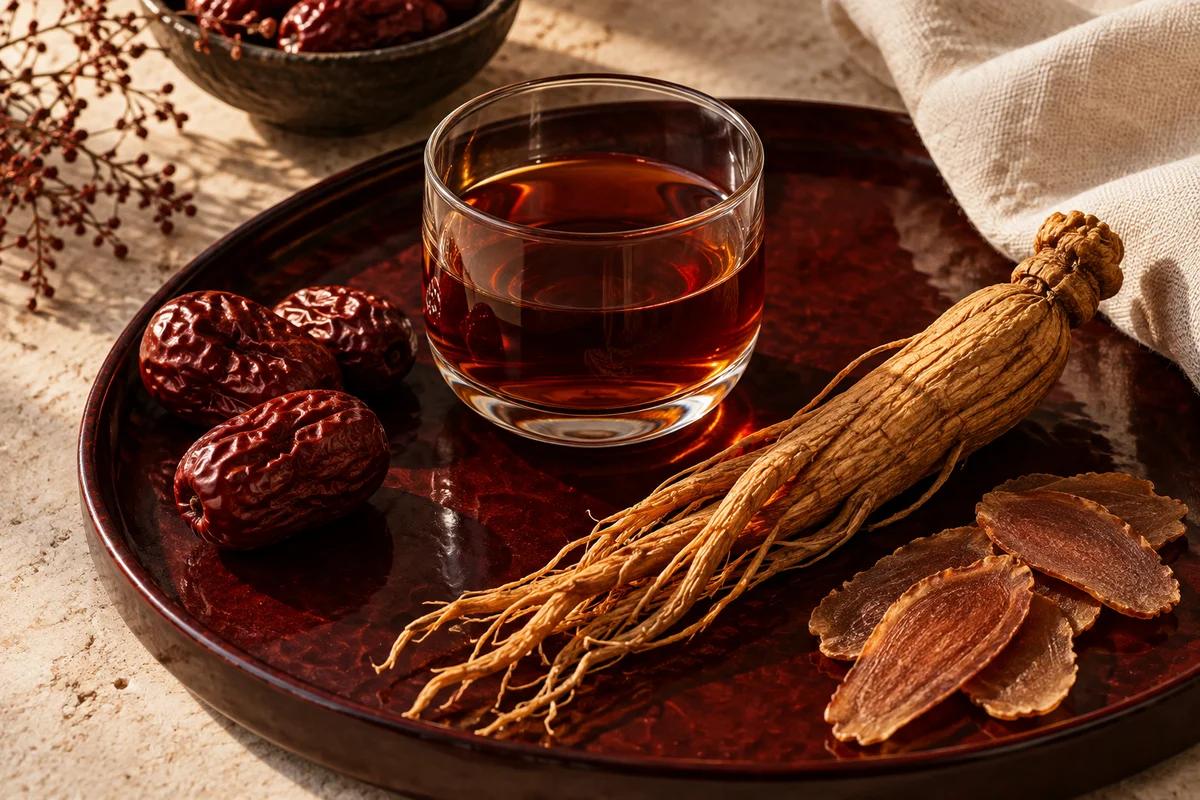
Open a box of the drink and first turn it over: one ingredient list, one nutrition label. They answer two different questions. The ingredient list shows which raw materials were used, listed in descending order by amount added, while the nutrition label tells you the actual values for protein, fat, carbohydrates, sodium, and so on in each serving of the finished product. Taking the Iron-Rich Red Ginseng Ejiao Peptide Hemoglobin Polypeptide Drink as an example, the ingredient list shows red date extract (6000 mg/bottle), red ginseng extract (200 mg/bottle), hemoglobin polypeptide (10 mg/bottle), and so on, but these numbers are the amounts of raw materials added, not the content of active ingredients or nutritional iron in the finished product.
Ingredient list: answers “what was used”
The information structure of the ingredient list is very simple: arranged from most to least. Water is usually first, followed by red date extract, red ginseng extract, and then sea cucumber peptide, American ginseng powder, polygonatum concentrate, ejiao peptide, codonopsis powder, reishi powder, poria powder, salmon hydrolyzed protein peptide, hemoglobin polypeptide, fish maw oligopeptide, black-bone chicken peptide, astragalus powder, lily powder, bird's nest peptide, longan powder, concentrated goji juice, concentrated red pomegranate juice, pyrroloquinoline quinone disodium salt, heme iron, ferrous glycinate, sodium iron ethylenediaminetetraacetate, niacinamide, citric acid, and sucralose.
A common pitfall here is mistaking the added amount in parentheses for “how much each bottle can supplement.” 6000 mg red date extract refers to how much of the raw material red date extract was added, not the content of red date polysaccharides or any one component; 10 mg hemoglobin polypeptide is likewise only the amount of raw material added. To further distinguish these two types of numbers, you can look at this整理 in Ingredient List Differences.
Another point that is often overlooked: the ingredients include red date extract, concentrated fruit juice, and sucralose, so it is not a sugar-free formula. Sucralose is a sweetener that provides sweetness but is not sugar; the actual sugar content must be checked back on the nutrition label.
Nutrition label: answers “how much per serving”
The core of the nutrition label is the values corresponding to “per serving” or “per 100 mL,” usually including energy, protein, fat, carbohydrates, sodium, and sometimes sugar. It measures the finished product, not the raw materials. In other words, what is written in the ingredient list does not mean the nutrition label will show a correspondingly high value.
Take this product as an example: each bottle is 50 mL, and each box has 7 bottles. If you want to control sugar intake, what you look at is the carbohydrates and sugar on the nutrition label, not whether “concentrated fruit juice” appears in the ingredient list. Similarly, although three iron sources—heme iron, ferrous glycinate, and sodium iron ethylenediaminetetraacetate—appear in the ingredients, the nutrition label does not necessarily list iron content separately; the materials also do not give a specific value for the iron content of the finished product, so it is not possible to infer from the ingredient list “how much iron each bottle contains.” This point is explained in more detail in Nutrition Label Interpretation.
A simple comparison:
| Dimension | Ingredient list | Nutrition label |
|---|---|---|
| Question answered | Which raw materials were used | How many nutrients per serving |
| Ordering method | Descending by amount added | Listed by fixed items |
| Meaning of numbers | Amount of raw materials added | Tested/calculated values of the finished product |
| Can it determine sugar content | No | Yes, look at carbohydrates and sugar |
| Can it determine iron content | No | Not provided in the materials; check the actual label |
Which one to look at first when purchasing
If you care about “what you are drinking,” look at the ingredient list first to confirm whether there are animal-derived ingredients, whether there are sweeteners, and whether there are ingredients you do not want. This product contains animal-derived ingredients such as sea cucumber peptide, salmon hydrolyzed protein peptide, black-bone chicken peptide, and ejiao peptide, so it is not vegetarian; people with fish allergies should not use it.
If you care about “how much you take in per bottle,” look at the nutrition label first, especially sugar, carbohydrates, and sodium. No matter how large the raw material addition amounts in the ingredient list are, they cannot replace the finished-product values on the nutrition label.
There is also a boundary to explain: this product is a food, not a medicine, and cannot replace a balanced diet. The materials do not promise improvement effects or a number of days to see results after drinking. If you continue to feel tired, unwell, or suspect iron deficiency, you should seek professional evaluation first rather than judging on your own based on the ingredient list.
How to fit it into daily habits
The product materials recommend drinking it after meals, shaking well before drinking, and drinking immediately after opening. For the daily amount, please follow the actual retail packaging label and do not increase the amount on your own. For storage, place it in a cool, dry place and avoid direct sunlight. The shelf life is 18 months; check the bottle for the expiration date.
People who should not use it need to be checked in advance: infants and young children, pregnant women, nursing women, children under 14 years old, and people with fish allergies should not use it. People who are taking medication or have special dietary needs should ask a medical professional before purchasing.
If you have already decided to make it one of your daily dietary choices, you can look at the product page for Red Ginseng Ejiao Peptide Daily Nourishing Drink and check the actual retail label again to confirm the ingredients and nutrition values. The ingredient list and nutrition label each cover one part; only by looking at them together is it less easy to mistake the amount of raw materials added for nutritional content.